A labor of love: The KAKE-TV Wichita Marathon and the meeting that changed the marathon

By Mark Chamberlin

In May 1980, Clark Ensz organized and directed the Wichita Marathon. Clark and I had become friends in 1979, as I — inspired by the books of Jim Fixx and Dr. George Sheehan — went “all in” on distance running. Just weeks before the 1980 marathon, I wrote and produced a public service announcement (PSA) at KAKE-TV to promote the event. The 30-second ad was well-received, and Clark and I soon set our sights on a similar message for the next marathon, scheduled for October 1981.

We scheduled a meeting with KAKE General Manager Martin Umansky to seek approval for a new series of on-air announcements. In the small second-floor conference room adjacent to Umansky’s office, we inserted a 3/4-inch U-matic videotape cartridge into a playback unit and played the 1980 PSA. After the piece finished, we asked if he and KAKE would be willing to support a similar effort for the 1981 race.

Martin replied, “Why don’t we just televise it, live, start to finish?”

Not knowing when to leave well enough alone, I chimed in, “Great, and I’m going to run it.”

Clark and I stepped out of the meeting and looked at each other, knowing neither of us had any idea how to produce a three-hour live broadcast.

Fortunately for us, KAKE had been aggressively pursuing sports broadcasting, including Wichita State University basketball and the Wichita Wings. These initiatives were led by station manager Ron Loewen. In another stroke of good luck, Loewen had just hired Darrell Ewalt, an up-and-coming sports producer who had spent time with the fledgling cable network ESPN. And thus the KAKE-TV/Wichita Marathon was born.

At a marathon planning meeting at Clark’s office near Douglas and McLean, Ewalt explained how he envisioned the three-hour coverage. He assembled a crew of 34 people, a helicopter, the relatively new microwave technology, a microwave-equipped truck, and a pickup truck with a microwave antenna to send in-race images up to the helicopter (SKY-10), then to the station and out to the audience. 

KAKE -TV representatives Steve Cless, director; Mark Chamberlin; and Stuart Volz, KAKE engineering, line up just before the start of the 1981 marathon. Volz is wearing a Bone Fone, a spandex-covered wearable neck radio that had speakers lying on the collarbones to conduct the sound through the bones, much like Shokz headphones.

On Sunday, Oct. 18, 1981, under sunny skies, then-Wichita police chief Richard Lamunyon fired the starter’s gun, and the live coverage was under way. Michael Hairston from Tulsa won the three-loop men’s race in 2:26:00, and Wichitan Jan Pearce took the women’s race in 3:17:26. There were 247 registered runners with 189 finishers, and broadcast history was made. One week later, ABC produced its first live coverage of the New York City Marathon.

In 1982, KAKE again provided live start-to-finish coverage. The technical highlight was a small wireless microphone wrapped around the chest of competitor Fred Torneden. Fred was intended to provide in-race commentary to give viewers a sense of the lead pack’s pace. However, after five miles, Torneden shed the mic near the broadcast field anchor desk at Amidon and Murdock. Despite the interruption, Torneden won the 1982 marathon in a state-record time of 2:18:08. Gary Gregory made a gut-wrenching effort to take second in 2:19:49, and Kathy Whitcomb set a new women’s state record of 2:48:37.
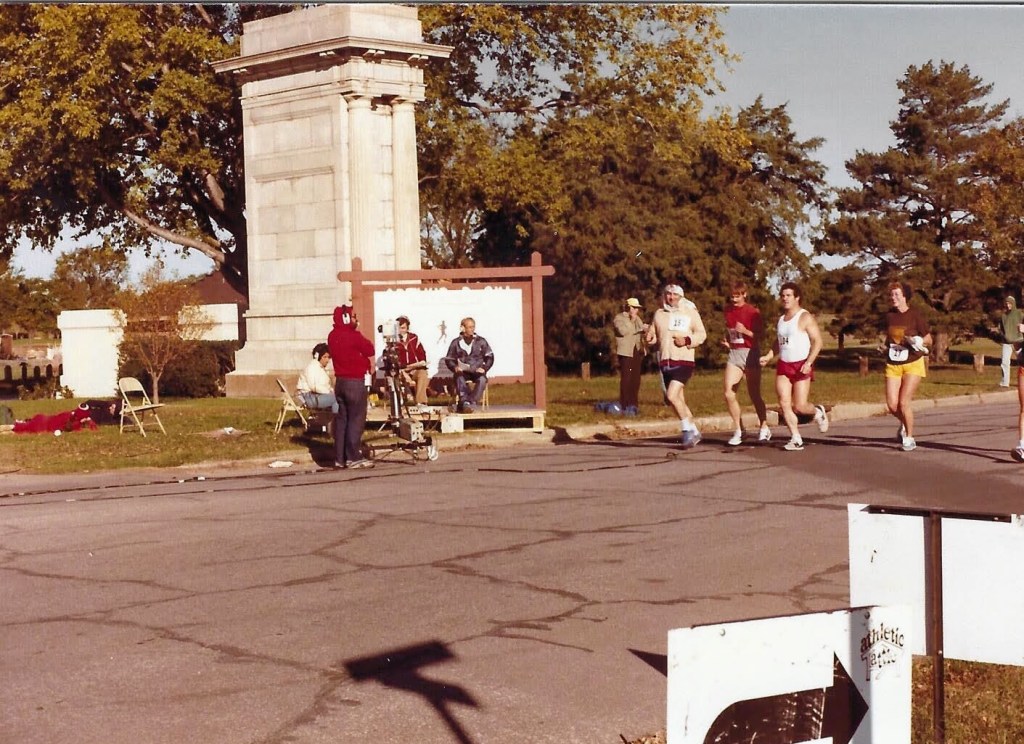
Broadcast HQ: Field anchor desk with Clark Ensz providing live play-by-play at the corner of Amidon and Murdock. The 1981 marathon was a 3-loop course in the Riverside neighborhood.

The 1983 KAKE-TV/Wichita Marathon featured a new course using Douglas Avenue and Central Riverside Park, finishing near the pitcher’s mound inside Lawrence-Dumont Stadium. Live television coverage was replaced that year by a 30-minute special, which aired Sunday afternoon, Oct. 18.

During the ensuing years, several different courses were used. In 1985, the event featured the St. Francis Mile for men and women, a one-mile race on Douglas Avenue. KAKE’s highlight special of the marathon and the St. Francis Mile eventually was added to the Museum of Broadcasting’s collection. By 1999, the marathon started in Derby and included a long stretch on McConnell Air Force Base, featuring a memorable run down the flight line and through a hangar housing a B-1B Lancer bomber.

The 1984 marathon featured a long stretch up Douglas Avenue to a College Hill turnaround.

Clark and I, along with photographer/editor Tim May, spent countless hours at KAKE producing these 30-minute highlight specials. After 32 years with the station — spanning news, promotion, and sales — I left KAKE in January 2005. I joined the advertising firm Armstrong|Shank (later Armstrong Chamberlin Strategic Marketing, and now AC Strategic Marketing) before retiring in May 2021. Today, I offer marketing and production services on a freelance basis. Clark continued to stage the Wichita Marathon until Oct. 10, 2010, when it transitioned to the Prairie Fire Marathon.

I remain proud of this “labor of love” and am grateful to Clark Ensz and the many others who support the Wichita running community. Most of all, I remain in awe of broadcast visionary Martin Umansky, who, in a single 15-minute meeting, changed the course of Wichita’s running history.

After a long stretch on McConnell AFB, runners circa 1999 exited the base by passing through a hangar housing a B-1 B Lancer bomber. Mark Chamberlin and photographer/editor Tim May are ready to record the video.

Photos courtesy of Mark Chamberlin.
Back of the Pack

By Jen Smith

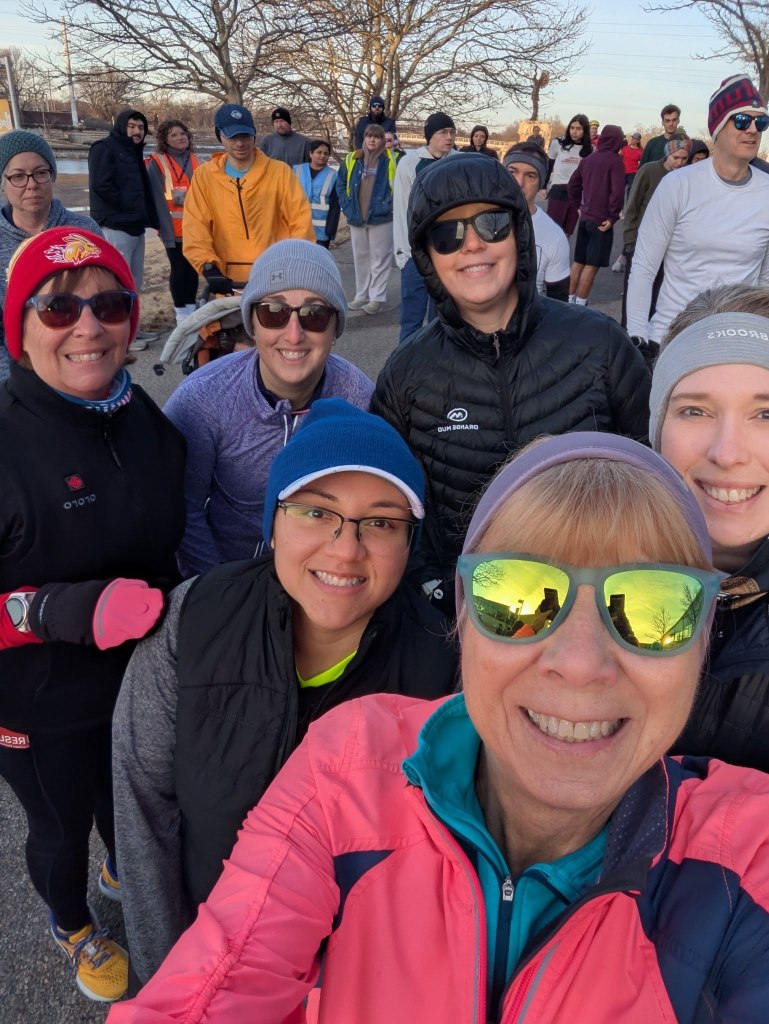
Coming to a group run can be intimidating at first. Stepping out of your car, everyone is already chatting away, adjusting shoelaces and gear, knocking out a few dynamic stretches to warm up. But fear not — group runs are all about getting to know other runners in town.

And if you’re a slower runner? Don’t worry. There is always a Back of the Pack club to make sure no one is left behind. Some groups even outlaw the word “slow,” because what might be “slow” for one runner is my absolute sprinting-until-I’m-going-to-vomit pace.

At every Run Wichita group run, there will be a leader to make some announcements, discuss the route and water stops, and hand out maps, if necessary. Usually it is our certified coach, Angela Stateler, but other board members fill in when she can’t make it. That leader also keeps an eye out for new faces and tries to pair the newbie up with others who run at a similar pace. But don’t be afraid to speak up and ask who runs at your planned pace. It’s more fun to have someone to chat with on a run. Or someone to whine and complain with about the cold…or the heat…or the wind…

You don’t even have to run at a group run. I’m still slowly working my way back from some knee issues a year and a half ago, so sometimes I just show up to walk a few miles. Nor do you have to be up for whatever the posted mileage is. Don’t wanna run 10 miles on a Saturday morning? No problem — Angela usually gives suggestions on how and where to shorten a route. Or there’s always the option of doing an out-and-back along the route for whatever mileage you desire.

To find out when and where the group runs are, visit the Run Wichita — Community Group on Facebook or the Member Workouts page on RunSignUp.

And if you’re still worried about being slow, remember — you’re faster than everyone at home on the couch!

Photo by Terri Vanwey.

My first Annual 4-Mile Super Bowl Sunday Race

By David Abbott

As the calendar turns to February in the wake of the biggest storm of the season, Run Wichita is gearing up for the mid-winter race that will usher in the spring running schedule.

The 34th Annual 4-Mile Super Bowl Sunday Race takes place in the hours before Super Bowl LX, featuring an out-and-back course open to participants of all fitness levels, walkers and runners alike.

David Abbott

It can also serve as an excuse to lounge around in pajama pants later in the day and eat healthy snacks while the Seattle Seahawks take on the New England Patriots for the championship of American football and the coveted Lombardy Trophy.

According to Run Wichita lore, the race began in the late 1980s as the Frozen Nose Four-Mile, sponsored by Mountain High, a now-defunct outdoor sporting goods store near Rock Road and Central Avenue.

The increasingly popular run was halted in the early ’90s, though, when a foot of snow fell on that January day, leading to the cancelation of the event.

The store owners subsequently discontinued the race, leaving an opening in the race calendar. Run Wichita founding members Clark Ensz and Mark Chamberlain decided the race would be a good fit on Super Bowl Sunday, resurrecting it and keeping the 4-mile distance and the Linwood Park location.

This will be my first time participating in one of the iconic events on the Run Wichita calendar in the wake of my return to Wichita last summer. 

Since discovering running in 2012 at the age of 51, I’ve made it a point to join local running organizations to financially support them and get to know the people around me who share my strange obsession with the suffering and elation that is running.

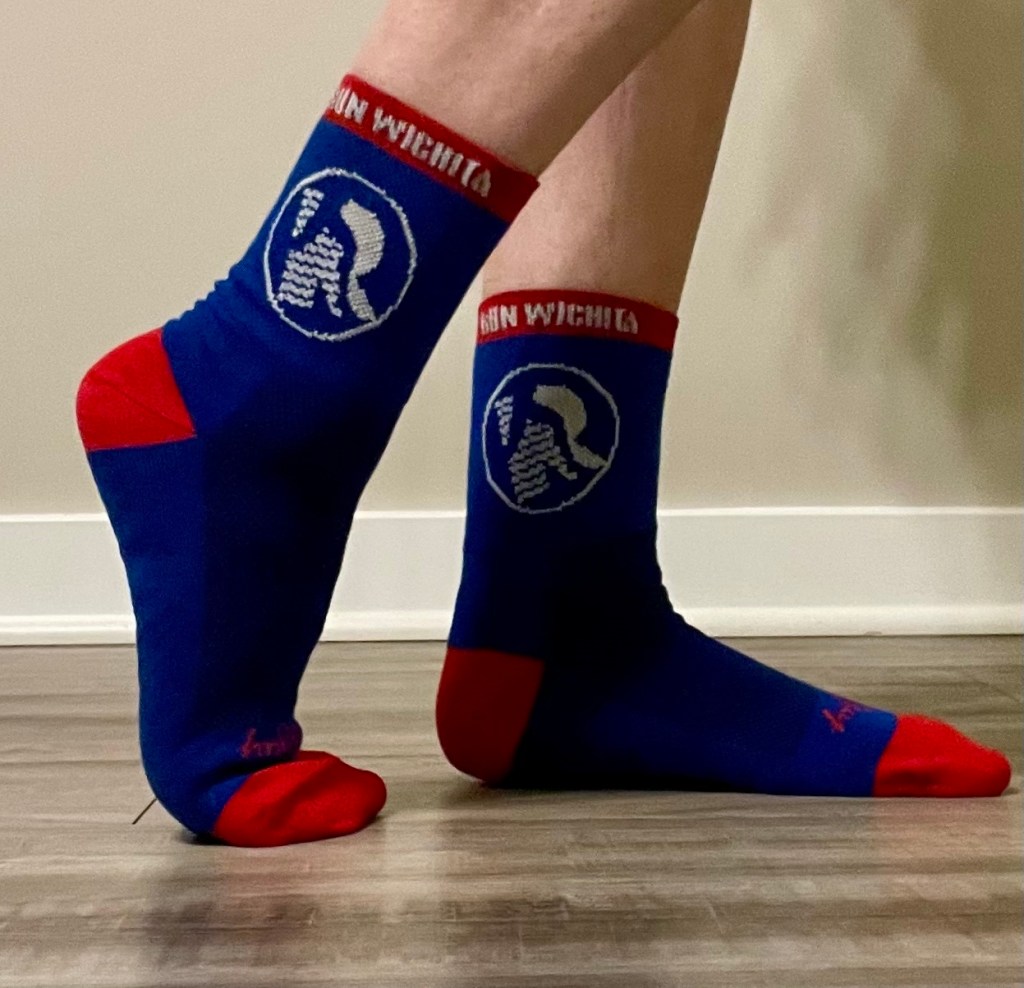
Super Bowl run swag — socks!

For me, every race is an opportunity to further submerge myself in local running culture and participate in a thriving community of dedicated runners of all ages and backgrounds.

As an added bonus, the 4-Mile Super Bowl Race features 50th Anniversary Run Wichita socks, offering another opportunity to get more running-related clothing for those of us who don’t have enough SWAG already.

The 34th Annual 4-Mile Super Bowl Sunday Race takes place at 2 p.m. Sunday, Feb. 8, at Linwood Park, 1901 S. Kansas St. Packet pick-up and in-person registration begins at 12:30 p.m. in the Linwood gym. There will be several merchant booths set up to browse and an opportunity to meet and hang out with other runners before the start of the race. 

For information or to sign up for the 34th Annual 4-Mile Super Bowl Sunday Race, go to www.runwichita.org or click on the link here.