
A labor of love: The KAKE-TV Wichita Marathon and the meeting that changed the marathon

By Mark Chamberlin

In May 1980, Clark Ensz organized and directed the Wichita Marathon. Clark and I had become friends in 1979, as I — inspired by the books of Jim Fixx and Dr. George Sheehan — went “all in” on distance running. Just weeks before the 1980 marathon, I wrote and produced a public service announcement (PSA) at KAKE-TV to promote the event. The 30-second ad was well-received, and Clark and I soon set our sights on a similar message for the next marathon, scheduled for October 1981.

We scheduled a meeting with KAKE General Manager Martin Umansky to seek approval for a new series of on-air announcements. In the small second-floor conference room adjacent to Umansky’s office, we inserted a 3/4-inch U-matic videotape cartridge into a playback unit and played the 1980 PSA. After the piece finished, we asked if he and KAKE would be willing to support a similar effort for the 1981 race.

Martin replied, “Why don’t we just televise it, live, start to finish?”

Not knowing when to leave well enough alone, I chimed in, “Great, and I’m going to run it.”

Clark and I stepped out of the meeting and looked at each other, knowing neither of us had any idea how to produce a three-hour live broadcast.

Fortunately for us, KAKE had been aggressively pursuing sports broadcasting, including Wichita State University basketball and the Wichita Wings. These initiatives were led by station manager Ron Loewen. In another stroke of good luck, Loewen had just hired Darrell Ewalt, an up-and-coming sports producer who had spent time with the fledgling cable network ESPN. And thus the KAKE-TV/Wichita Marathon was born.

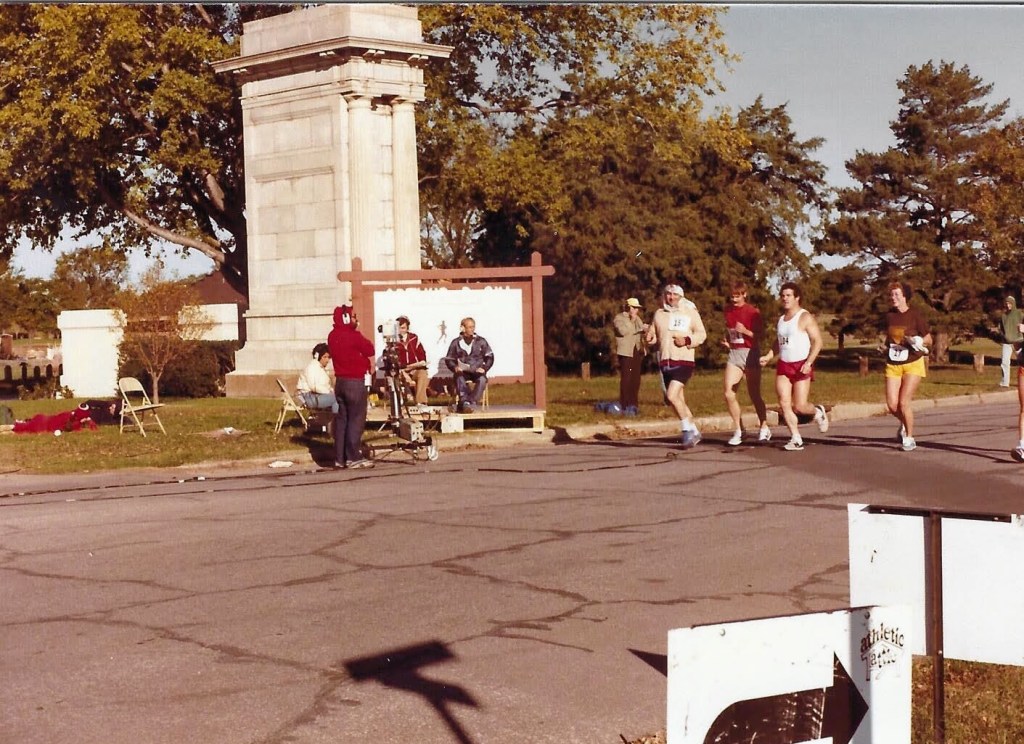
At a marathon planning meeting at Clark’s office near Douglas and McLean, Ewalt explained how he envisioned the three-hour coverage. He assembled a crew of 34 people, a helicopter, the relatively new microwave technology, a microwave-equipped truck, and a pickup truck with a microwave antenna to send in-race images up to the helicopter (SKY-10), then to the station and out to the audience. 

KAKE -TV representatives Steve Cless, director; Mark Chamberlin; and Stuart Volz, KAKE engineering, line up just before the start of the 1981 marathon. Volz is wearing a Bone Fone, a spandex-covered wearable neck radio that had speakers lying on the collarbones to conduct the sound through the bones, much like Shokz headphones.

On Sunday, Oct. 18, 1981, under sunny skies, then-Wichita police chief Richard Lamunyon fired the starter’s gun, and the live coverage was under way. Michael Hairston from Tulsa won the three-loop men’s race in 2:26:00, and Wichitan Jan Pearce took the women’s race in 3:17:26. There were 247 registered runners with 189 finishers, and broadcast history was made. One week later, ABC produced its first live coverage of the New York City Marathon.

In 1982, KAKE again provided live start-to-finish coverage. The technical highlight was a small wireless microphone wrapped around the chest of competitor Fred Torneden. Fred was intended to provide in-race commentary to give viewers a sense of the lead pack’s pace. However, after five miles, Torneden shed the mic near the broadcast field anchor desk at Amidon and Murdock. Despite the interruption, Torneden won the 1982 marathon in a state-record time of 2:18:08. Gary Gregory made a gut-wrenching effort to take second in 2:19:49, and Kathy Whitcomb set a new women’s state record of 2:48:37.
Broadcast HQ: Field anchor desk with Clark Ensz providing live play-by-play at the corner of Amidon and Murdock. The 1981 marathon was a 3-loop course in the Riverside neighborhood.

The 1983 KAKE-TV/Wichita Marathon featured a new course using Douglas Avenue and Central Riverside Park, finishing near the pitcher’s mound inside Lawrence-Dumont Stadium. Live television coverage was replaced that year by a 30-minute special, which aired Sunday afternoon, Oct. 18.

During the ensuing years, several different courses were used. In 1985, the event featured the St. Francis Mile for men and women, a one-mile race on Douglas Avenue. KAKE’s highlight special of the marathon and the St. Francis Mile eventually was added to the Museum of Broadcasting’s collection. By 1999, the marathon started in Derby and included a long stretch on McConnell Air Force Base, featuring a memorable run down the flight line and through a hangar housing a B-1B Lancer bomber.

The 1984 marathon featured a long stretch up Douglas Avenue to a College Hill turnaround.

Clark and I, along with photographer/editor Tim May, spent countless hours at KAKE producing these 30-minute highlight specials. After 32 years with the station — spanning news, promotion, and sales — I left KAKE in January 2005. I joined the advertising firm Armstrong|Shank (later Armstrong Chamberlin Strategic Marketing, and now AC Strategic Marketing) before retiring in May 2021. Today, I offer marketing and production services on a freelance basis. Clark continued to stage the Wichita Marathon until Oct. 10, 2010, when it transitioned to the Prairie Fire Marathon.

I remain proud of this “labor of love” and am grateful to Clark Ensz and the many others who support the Wichita running community. Most of all, I remain in awe of broadcast visionary Martin Umansky, who, in a single 15-minute meeting, changed the course of Wichita’s running history.

After a long stretch on McConnell AFB, runners circa 1999 exited the base by passing through a hangar housing a B-1 B Lancer bomber. Mark Chamberlin and photographer/editor Tim May are ready to record the video.

Photos courtesy of Mark Chamberlin.

Why Runners Run

Running is more than a sport. It’s a rhythm, a ritual, a release. Ask a dozen runners why they run, and you’ll get a dozen different answers—each deeply personal, yet universally resonant.

Here are a few universal reasons you may hear:

Mental Clarity

Many runners lace up their shoes not just to move their bodies, but to still their minds. The repetitive cadence of footfalls becomes a meditation. In the quiet of early morning or the hush of twilight, running offers a rare solitude—a space to think, to breathe, to reset.

Physical Strength

Running builds endurance, tones muscles, and strengthens the heart. But it also teaches resilience. Every mile conquered is a testament to persistence. Whether training for a marathon or jogging around the block, runners push past limits—proving that strength isn’t just measured in speed or distance, but in the will to keep going.

Community

Running connects people. From local 5Ks to global events like Global Running Day, the sport fosters camaraderie. Runners cheer each other on, share routes, swap stories, and celebrate milestones together. It’s a community built on shared sweat and mutual encouragement.

Purpose

Some run for causes—raising awareness, funds, or hope. Others run to mark personal victories: overcoming illness, grief, or self-doubt. Every runner has a story, and every run adds a new chapter.

Freedom

Running is accessible. No fancy gear required. No membership fees. Just you, your shoes, and the open road. It’s a celebration of movement, of being alive, of choosing your own pace and path.

The reasons we run are as varied as the terrain we cover. But at the core, runners run because it makes them feel more like themselves—stronger, freer, and more connected.

Why do YOU run? Focus on this answer the next time you are struggling with motivation or find yourself having a “bad” run.

How to Start a Running Streak: Insight for Beginners

Starting a running streak can be an exciting and rewarding challenge. Not only does it help improve your fitness and build discipline, but it also offers numerous benefits such as increased mental clarity, better mood, and a sense of accomplishment. Whether you’re looking to enhance your physical health, enjoy the thrill of saying you’re “streaking,” or simply build a consistent routine, here are some valuable insights from local runners who have successfully maintained their streaks.

Getting Comfortable with the Early Days

One runner shared, “I had to get comfortable with days 1-13… I had to restart often and give myself grace when I did. I got farther when I figured out my reasons why I wanted to streak. Plus I loved saying that I was streakin’ to shock non-runners.” The initial phase can be tough, but understanding your motivations and being kind to yourself when you need to restart can make a big difference.

Starting Slow and Building Up

Another runner advised, “Start slow to make sure your body can handle it. I started with 30 days, then went to 60 days, then 90 days, then 6 months. Then the following year, I set a goal for 1 year. My body seems to like streaking, and I find I get less injuries and get sick less.” Gradually increasing your streak duration helps your body adapt and reduces the risk of injuries.

Setting Goals and Boundaries

Setting clear goals and boundaries is crucial. One runner mentioned, “Set your goal and boundaries ahead of time. For me, my goal was to run at least 1 mile straight every day. After the 1 mile, I didn’t care if I ran or walked. When traveling, I used the time in Wichita as my ‘day’. I may have had a few runs in airports to keep my streak.” Having a minimum daily requirement and being flexible with how you achieve it can help maintain consistency.

Designing Your Streak to Fit Your Lifestyle

A runner who has been streaking for three years shared, “Design yours to work for you. I kept failing when I made it a run-only streak. When I changed to walk or run 1 mile every day, that walking helped me keep my streak going. Those days I had that were really long or my body needed rest; I was able to walk just my mile and feel good.” Tailoring your streak to include walking can make it more sustainable, especially on days when running feels too demanding.

Just Do It

Finally, one runner emphasized the importance of commitment: “It’s not for everyone, but if you decide to do it, just do it. Sometimes it’s easier to decide when you’re going to run, not if. Know your limitations and think about barriers like illness or travel.” Deciding to run every day, regardless of circumstances, can help you stay on track.

Tips for Starting Your Running Streak

1. Understand Your Motivation: Know why you want to start a streak. This will keep you motivated during tough days.

2. Start Slow: Begin with a manageable goal, like 30 days, and gradually increase it.

3. Set Clear Goals: Define what counts as a streak for you. It could be running or walking a certain distance every day.

4. Be Flexible: Allow yourself to walk if running feels too challenging on some days.

5. Plan Ahead: Consider potential barriers like travel or illness and have a plan to overcome them.

6. Commit: Decide that you will run every day and stick to it.

Starting a running streak is a personal journey, and what works for one person might not work for another. The key is to find a routine that fits your lifestyle and keeps you motivated. Happy streaking!