
Behind the Starting Line: How to Organize a Race

Race day can bring a lot of excitement, the adrenaline rush of the crowd, the pulsating music, and just an overall electrifying atmosphere. You ever wonder how much work is put in before the runners get to the starting line? From securing permits and sponsors to mapping out the course and ensuring participant safety, each step plays a crucial role in creating a memorable race day.

Karlee Rose, president of Run Wichita, gives us a glimpse behind the scenes into what makes races like our annual Moonlight Madness come to life for our local running community.

How far in advance should planning start?

KR: It depends on the race. For Run Wichita races, discussions start about 5-6 months in advance. For races that are more than a “fun run” and have a large attendance, 12 months would be the least.

How much does it cost to put on a race?

KR: The cost can vary depending on the purpose of the race, the swag, and the size of the event, so the larger the race, the higher the registration cost. Registration fees are typically the primary source of funding, unless you get sponsorships. For Run Wichita races, we focus on the community aspect of the races and covering the race costs. Races that want to gain profit or raise money for charity will need to have a higher registration fee or larger sponsorship. Early bird pricing for events encourages people to sign up in advance. For larger cities, this is up to a year in advance, but local races will open 3-6 months before race day.

How do sponsorships help?

KR: Partnerships and sponsorships can help a race financially or give services, products, volunteers, increase promotion, or whatever your race needs. For a race to grow in any way, partnerships and sponsors are needed. Our running community is very good at creating partnerships and helping each other out where we can.

How do you choose a race location and course?

KR: There are so many aspects that go into the decision: distance, terrain, scenery, road closures, and permits needed. Ideally, you want to choose a location that hasn’t been overused with past races. You can also get a course to be certified for other events, which a timing company will help with for a fee. This is why many certified races like to stick with the same course. If any changes are made to the course, even if there is construction, the course must be re-measured and re-certified.

What about the course conditions?

KR: Every race course needs to be checked several times leading up to the race, but specifically on the event day to take care of any needs or unforeseeable happenings, like obstacles. Weather is also a big factor for any race. Race plans should include a weather contingency plan. During the race, it’s important to make sure each participant has a great experience. This means waiting until the last participant crosses the line and making sure they have the same amenities as the first participant to cross the line. Clean up starts after that and it’s helpful to already have volunteers scheduled to help.

Do all races need permits from the city?

KR: Most races (if put on legally) will need to gain permits or permission of some kind. Run Wichita has chosen race locations where we do not need street closure permits, which is helpful. Permits depend on the type of race so if you are trying to organize a race, check with the local government early in the planning process. Races also need to have insurance coverage to protect the company or organizer of the event. All these things take time and money to obtain.

What about promotion and advertising?

KR: Clark Ensz (well-known Wichita race director) once told me that a person must see race information 7 times before they register, so promotion is important. People must know your race exists to sign up. I’ve always believed that word of mouth is the best form of advertising.

Time is important to a lot of runners. How do you time races?

KR: Race timing is a major cost of a race, but time and placement is what most participants want from these events. Timing companies are available and can offer other services for more fees to help free up some time and effort from the race organizers, like race photography, course certification, and results submission on certified courses.

What about medical and hydration stations?

KR: You can never have too many first aid or hydration stations, but the logistics behind it is the hard part. Finding the right location to standup the items, having enough tables, cups, water and fuel, finding volunteers to work the table for the duration you have it set up, and making sure volunteers know how to work an aid station are just a few things to coordinate.

How about the snacks or post-race treats?

KR: Food is my personal favorite part about a race! I think most participants have come to expect some sort of hydration and snack after they cross the finish line. The longer the race in distance, the more food participants expect. This is yet another cost that takes a lot of pre-planning. We chose to have food as a big part of our Moonlight Madness run because it helps bring people together and get to know each other.

Most runners love free swag! How do you decide what to offer?

KR: This is an area that is hard to please everyone. Swag can often draw people to your race to take part or keep them coming back. But no matter what is offered, there will be complaints. Medals are the biggest crowd pleaser and staple for most races. T-shirts used to be the most common race swag, but now you see other apparel items, accessories, or practical and useful giveaways. Run Wichita has tried to stick with current trends for our race swag, but sometimes it’s hard to come up with something unique AND affordable.

Aside from medals, what about age division awards?

KR: I feel like age division recognition is always appreciated by participants. It can be a motivator and source of encouragement, and also keep participants coming back every year. Most races do 10-year divisions others do increments of five. Typically, there is some sort of “prize” that comes with the recognition, so this is another cost to consider. A timing company can sort out the age divisions.

Bathrooms are a must, right?

KR: Every race needs an adequate number of toilets! Sometimes restroom facilities will be available onsite but almost always portable toilets will need to be considered. In general, races should have 1 toilet for every 50 participants, but remember there will also be spectators to consider.

Let’s not forget about the volunteers!

KR: Volunteers are the backbone of a race. Without them, the event doesn’t happen. But getting race volunteers can often be more difficult than participants. I think participants of races are always very good about being kind and showing gratitude to those that take time to volunteer.

Conclusion

Organizing a race requires careful planning and coordination to make sure the event runs smoothly and leaves a lasting impression on participants and spectators alike. Run Wichita would like to offer a big thank you to all our volunteers, partners, and sponsors who supported the Moonlight Madness race and other races within our community. If you’re not running a race, consider being one of the volunteers for an upcoming event and be a part of something special. See you at the starting line!
Spice up your run with shoe testing

Are you a runner looking to spice up your running experience with a new pair of shoes? Look no further than your local running store where demo days and groundbreaking technology are changing the game in shoe testing and selection.

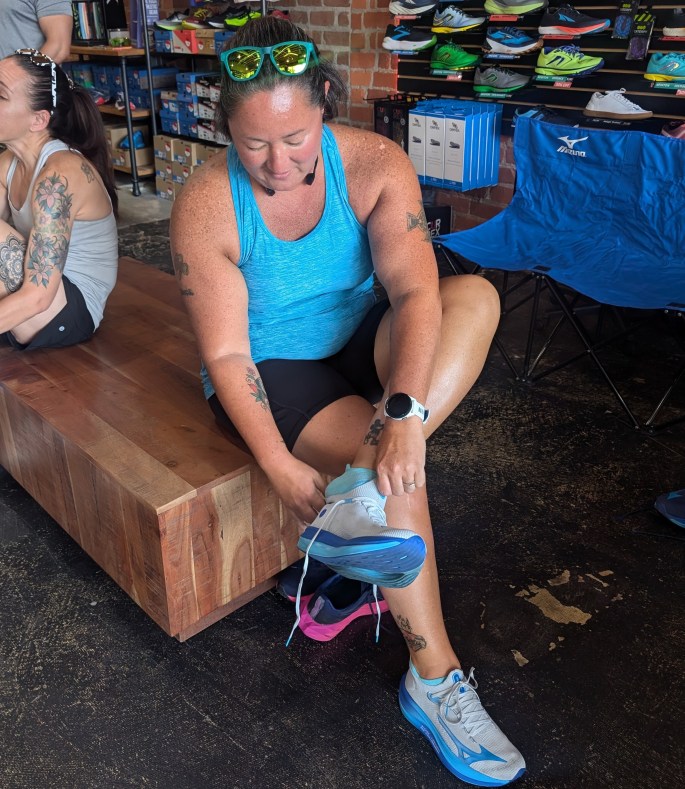
Shoe demo events at running stores, like Fartleks Running Shop Smoothie Stop, offer a creative and enjoyable opportunity for runners to discover their next favorite shoe. Participants get a firsthand look at what’s new on the market and have a chance to literally take that footwear on a test drive in a group run.

Andrew Schinstock, owner of Fartleks Running Shop Smoothie Shop, says that his demo days are driven by the desire to offer more than just the tried-and-true brands. “The shoes I select are the ones that are the most unique and interesting. It’s for people who want to try something different,” said Andrew. 

He also believes in integrating customer feedback when deciding on what shoe to feature, responding to the needs and interests of the local running community. “If I hear people talking about how they want to try a certain shoe, I’ll try to plan a demo day for that one. My goal is to help people find a better shoe and get out of the generic box of running shoes,” he explained.

Plans are in motion to increase the frequency of demo days at Fartleks Running Store, but runners can also check with other local running stores for their events.

Shoe demo days are not the only way for runners to find their next daily trainer or racing shoe. Many running stores also offer personalized foot analysis, such as advanced 3D foot scanning technology. This technology is the same as what’s utilized by leading footwear giants to design shoes to meet a wide array of foot shapes and needs. The scanners provide detailed measurements of your foot, assessing length, width, and arch height, to pinpoint shoes that offer the right balance of support and stability for your feet. Foot analysis is commonly offered without an appointment, but contact your favorite store for more information. 

If you’re tired of the same old, generic running shoes and are ready to try something new and exciting, head to your local running store for a demo day or foot analysis soon!

Can you stretch too much?

From school age, we are taught that stretching is an important part of physical activity to prevent injury and help us perform better. But is it possible to stretch too much? We asked Chris Burnett, strength and running specialist at True Physical Therapy, to weigh in on the importance of stretching for runners and how to make sure it’s effective.  

Dynamic vs Static stretches

First, let’s define the main types of stretching that are beneficial to runners. Dynamic stretching is controlled movement in and out of positions, instead of holding it in place. These stretches are to wake up your muscles and prepare your body for the workout. Static stretches are those bend-and-hold type of stretches you may be most familiar with and are best served after the workout is complete.

While both types of stretches are beneficial, they should be done with intention. “You don’t want to stretch just for stretching sake,” Chris says. “Sometimes we think that if we do this long, drawn-out stretching program that it will reduce our risk to injury, and the research doesn’t necessarily back that theory up.”

If you have areas that are tight and maybe need a little extra work, it won’t hurt to spend a little more time focusing on those areas. The biggest thing is to get your heart rate up, get the blood flow going and then use your stretches, especially during the warm-up, as a check-in with yourself to gauge how you’re feeling and if there’s any issue to address.

Focus areas for runners

When it comes to stretching, you want to think of going from the top down. In addition to your warm-up and cool down routines, there are some areas that Chris says runners should always include.

  • Hip extensions: movements that open up the hip joint; stronger hip extensor muscles can help you move more powerfully and prevent injury
  • Ankle dorsiflexion: pointing your toes up toward your shins; this helps your foot absorb the shock of landing
  • Thoracic rotation: upper back mobility exercises such as side bends and seated rotations

“We don’t think of thoracic rotation with running, but there’s a little bit of that to counterbalance the hips when we run,” said Chris.

Another focus area that is often overlooked is the big toe. “Your big toe needs to be able to bend when you push off, so you need to be able to have good motion there.”

It’s important for runners to find the right balance when it comes to stretching and listen to their body. If you’d like to reach out to Chris to learn more about True PT or strength training, contact him at chris@trueptwichita.com  or 607-743-9560.

Should you invest in a running coach?

Tis the season for fall race training! Runners will soon begin preparing for 5ks, half marathons, full marathons, or longer races scheduled for early fall. There are so many ways to train, from online programs, apps, and even programs on our smartwatches. However, some runners may need more motivation and guidance to reach their goals. In some cases, a running coach may be just the answer. How do you know if you should invest in one and when is the right time?

Investing in a running coach is a personal decision based on your needs and financial ability. Runners hire coaches for a variety of reasons, but mainly to get a personalized plan tailored to their goals. That could be increasing speed or endurance, or even stepping into a longer distance, such as moving from a 5k to a half marathon. 

Running coaches are not just for those new to the sport. Seasoned runners can also find coaching beneficial. For those runners whose training has plateaued or whose performance is stagnant, a coach may provide a much-needed boost or expertise to answer questions or discuss new race strategies.

Coaching can be done in private or group sessions. The cost of training plans varies by coach, but there are alternatives if cost is a factor. Angela Stateler, Run Wichita (RW) board member and a certified running coach, serves as the lead for RW’s Tuesday Track Nights and group runs on Thursday and Saturday. She says that although these are group workouts, many aspects are tailored to meet the various levels of the participants.

“Specifically for track night, we have two tailored programs. One for individuals who may be just getting into running or getting back into running. Then there’s a program for those who are more advanced or seasoned,” Angela said. “Sometimes the workouts are similar, and other times the speed is different for the seasoned runner versus the beginner. But it is still a form of coaching because it provides them with what the workouts look like.”

Things to consider:

If you’re thinking about hiring a running coach, here are some things to think about:

  1. Determine your WHY. Do you want to train for your first race or a new distance? Perhaps you want to improve on a previous time? 
  2. Think about WHAT. Is there a specific area or two you want to focus on? For example, maybe you are comfortable with your mileage but need assistance with speed workouts. 
  3. Figure out HOW. How often do you want to have check-ins with your coach? Do you expect to connect weekly, monthly, or as needed?

If you are interested in hiring a coach, visit the About Us section on RunWichita.org for a list of some coaches in our area. More information about Tuesday Track Night and group runs are also available on our website or on Run Wichita’s Facebook page.

Wichita Celebrates Global Running Day

It’s Global Running Day and we’re celebrating in the city of Wichita! On Tuesday, June 4, the city of Wichita issued a proclamation in recognition of Global Running Day 2024, highlighting the city’s dedication to promoting physical activity and healthy living. Run Wichita board members were on hand to accept the proclamation on behalf of the entire running community in Wichita and surrounding cities. On Wednesday, June 5 at 6 pm Run Wichita and Fartleks Running Shop invites the community to a free social run and free smoothies in honor of Global Running Day. 

Global Running Day is a worldwide celebration of running that encourages people of all ages, backgrounds, and abilities to move. Formerly started as National Running Day in 2009, this global celebration of running annually sees millions of people across several countries pledging to run.

Wichita has a great running community, with several paths, trails, local races, and run/walk groups to support everyone’s ability and goals. You are also bound to find local community leaders walking or running through the city, to include Wichita’s mayor, Lily Wu. 

Mayor Wu has been recently participating in 5k races and says she enjoys walking and jogging through our beautiful city. Run Wichita asked her to share her thoughts in honor of Global Running Day.

Q: What does running mean to you?

Mayor Wu: I love to get out and experience our city and spend time with neighbors. Running also provides a sense of accomplishment and fulfillment. I hope to encourage more people to step out of their comfort zone and participate.

Q: Are there any life lessons you’ve learned from running?

Mayor Wu: Anyone can confront and overcome challenges as long as they commit to the achievement. In addition to cardiovascular health, running can also be very mentally healthy. 

Q: As Wichita’s mayor, what are your thoughts about our running community? 

Mayor Wu: I really appreciate our running community, promoting a positive and healthy activity, welcoming everyone, and helping build a united community. 

Thanks Mayor Wu and city council members for being an active part of our running community! 

To our friends in Wichita and surrounding communities, let’s run together on Global Running Day and beyond to celebrate our love for running as we progress toward healthier and more active lives. Let’s run as one – today and every other day!