
By Jen Smith
Weather’s weird, ya know?
I don’t just mean the spring severe weather shenanigans that blesses Kansas every year, though that certainly can make it challenging to squeeze a workout in before the thunderstorms flare up.
What’s weird to me is how just a few degrees of temperature variation can mean the difference between a great run and a terrible run. I have a knee that’s still a little cranky two years after a knee scope and it’s been frustrating to be limited to “just” 3 or 4 miles when all my pals are knocking out 8, 10, and more.
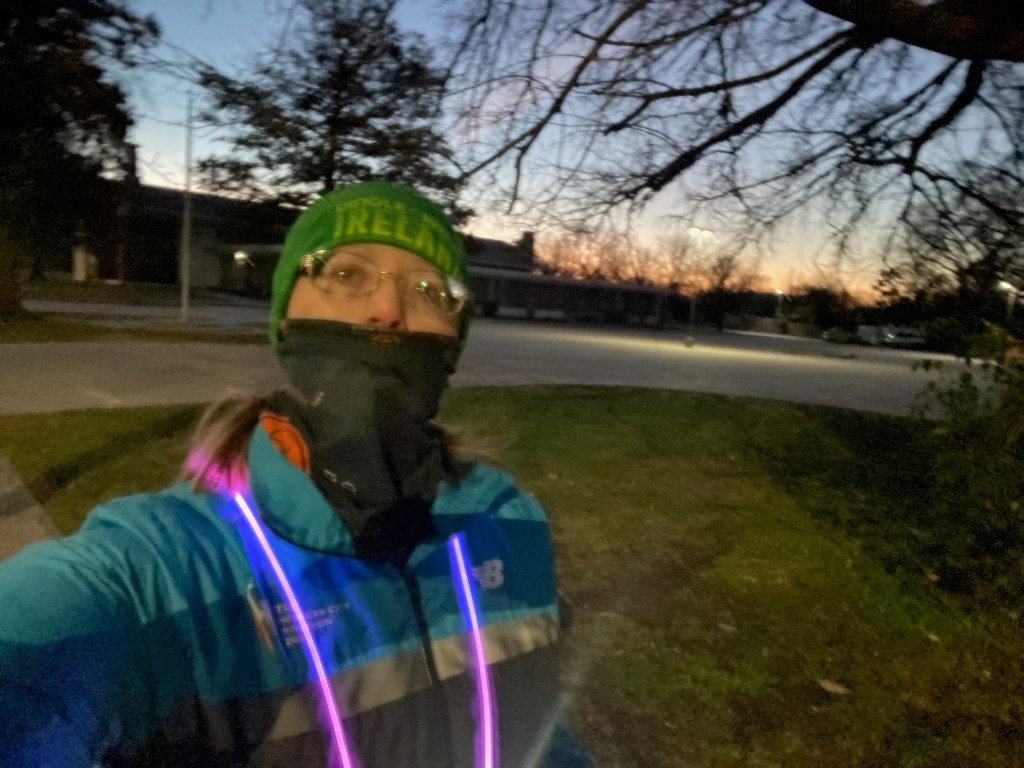
But a week ago, it was about 40 degrees on Saturday morning, and I had a glorious 4-mile run. Then I got to thinking back to another great run in March, and Garmin Connect tells me it was in the low 50s that morning. So what gives?
Although studies show mixed results, there is a weak correlation between the weather and joint pain. According to WebMD, it isn’t just the barometric pressure that affects joints, but also the temperature, humidity, and precipitation. The barometer may make tendons, muscles, and scar tissue expand and contract, leading to discomfort. (In a sample size of 1 — me — I can confirm this. 🤣) The synovial fluid in joints also can feel thicker at lower temperatures, making them feel stiffer.
The Orthopedic & Sports Medicine Center of Oregon has information across other weather patterns:
- Cold temperatures and joint stiffness: Cold weather reduces blood circulation, making joints and muscles feel tighter. This is particularly common for people recovering from knee replacements, hip replacements, or rotator cuff surgery.
- Barometric pressure drops and inflammation: When the air pressure outside decreases (like before a storm), tissues inside the joints may expand, pressing on nerves and increasing pain.
- High humidity and swelling: Warm, humid conditions may trigger fluid retention, leading to additional swelling in the knees, ankles, and wrists.
- Extreme heat and joint fatigue: Heat waves can dehydrate the body, reducing joint lubrication and leading to stiffness or muscle cramps.
Honestly, we can have all those weather conditions in the same day in Kansas, right?
So it looks like 40-50 degrees is that sweet spot for my knee, and it might be a few months before I get a day like that again. But maybe I’ll get super nerdy this summer with the weather data and how my knee feels on runs to see if I can find more sweet spots. ‘Cause if there’s one thing I know about Kansas, the weather will continue to be weird.
 Est. 1976